By PinkBazaar.in | October 2025
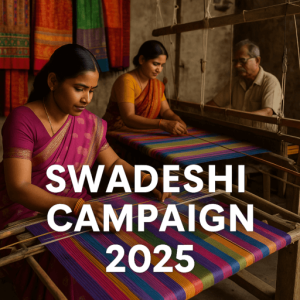
India’s fashion and textile industry is entering a revival phase — not through imported trends, but by embracing its own heritage. The Government of India has officially launched the “Swadeshi Campaign”, a nationwide initiative to promote Indian-made textiles, handlooms, and handicrafts.
With a target to make the domestic textile market worth USD 250 billion by 2030, this campaign aims to shift consumer attention from foreign labels to homegrown craftsmanship, reinforcing India’s position as a global textile powerhouse.
🧵 What Is the Swadeshi Campaign?
The Swadeshi Campaign is a central government initiative under the Ministry of Textiles, designed to celebrate, modernize, and market “Made in India” apparel and fabrics.
Its goals are threefold:
-
Encourage Domestic Consumption – Inspire Indians to buy and wear Indian-made fabrics, from cotton to khadi.
-
Boost Local Production & Employment – Support handloom weavers, rural artisans, and small textile manufacturers.
-
Position India as a Global Fashion Leader – Blend traditional techniques with modern design to attract global buyers.
This initiative follows the success of Vocal for Local and Atmanirbhar Bharat, extending their principles specifically into the textile and fashion ecosystem.
🌸 Why the Campaign Matters for India’s Fashion Sector
-
Empowering Rural Artisans
India’s handloom industry employs over 35 lakh artisans, many of them women in rural regions. Swadeshi awareness and government-backed retail opportunities could significantly uplift their incomes and preserve ancient weaving traditions. -
Sustainable Fashion Boost
Unlike mass-produced synthetic wear, India’s natural fabrics — khadi, linen, organic cotton, tussar silk — are eco-friendly and biodegradable. Promoting these aligns with the global sustainability movement, making Swadeshi not just patriotic but planet-friendly. -
Reviving Lost Crafts
Art forms like Chanderi, Jamdani, and Kanchipuram weaving have been struggling against mechanized competition. The campaign plans to create craft clusters and digital platforms to showcase and sell these products directly to consumers. -
Consumer Pride & Identity
Swadeshi is not about rejecting global fashion — it’s about reclaiming identity through design. Wearing Indian is becoming a statement of cultural confidence and ethical consumption.
🧶 The Market Outlook
India’s textile sector contributes about 2.3% to national GDP and nearly 12% of export earnings. The domestic apparel market alone is worth around ₹8.5 lakh crore (USD 100 billion), projected to double by 2030.
The Swadeshi push could unlock:
-
Growth for SMEs and cottage industries,
-
New jobs in weaving, dyeing, and embroidery,
-
Global recognition of India’s textile artistry.
Large players like Reliance Retail, FabIndia, and Taneira (Titan Group) are already sourcing from Indian artisans and integrating traditional fabrics into modern silhouettes, bridging old and new India.
🪡 Digital Meets Handcrafted
Interestingly, the Swadeshi campaign isn’t just offline. The Ministry of Textiles is working with e-commerce and social media platforms to promote “Buy Indian” collections and run awareness drives during festivals like Diwali and Raksha Bandhan.
AI and blockchain technologies may soon be used to verify fabric authenticity and artisan origin, ensuring transparency and traceability — a key factor for millennial and Gen Z shoppers.
🌿 Voices from the Industry
“The Swadeshi campaign is the revival India’s handloom industry has been waiting for,” says Ramesh Sharma, founder of a Jaipur-based cotton apparel brand.
“It’s not just about heritage — it’s about showing the world that Indian textiles can lead the global conversation in sustainability and craftsmanship.”
Fashion designers such as Anita Dongre and Sabyasachi Mukherjee have long promoted handwoven and eco-conscious designs, setting a precedent for mainstream adoption.
💫 Final Takeaway
The Swadeshi Campaign is more than a government program — it’s a movement of rediscovery. By wearing Indian, consumers support a circular ecosystem that sustains artisans, reduces imports, and revives India’s proud textile legacy.
As India’s designers and consumers unite under this banner, the world may soon look to India not just for inspiration — but for leadership in sustainable, ethical fashion.
Tags:
#SwadeshiCampaign #IndianTextiles #VocalForLocal #SustainableFashion #HandloomIndia #AtmanirbharBharat #PinkBazaarNews